A law firm’s office needs to support confidential work and provide a setting where clients feel comfortable discussing sensitive matters. With a wide choice of private serviced offices on flexible terms across central London, it helps to approach a viewing with a clear understanding of what your practice needs from the building.
From location and privacy to the impression your clients form when they arrive, we’ve explored the key considerations to help you assess how well an office would suit your firm.
Key takeaways:
- The building’s layout and everyday procedures should support your firm’s confidentiality requirements, including how conversations, visitors and sensitive information are handled
- Clients may only see reception and a meeting room, so the welcome they receive and the comfort of those surroundings deserve attention during a viewing
- Location should reflect the way your practice works, balancing journeys to courts and counsel with convenient access for your team and clients
- Check notice periods for both parties and whether you can expand or reduce your office during the agreement, particularly if your headcount changes with your caseload
How office requirements differ for law firms
Headcount, cost and commute will all shape your choice of office, but a law firm also needs a building that supports its duty to keep clients’ affairs confidential.
Conversations in corridors can be as sensitive as the documents on your desk or computer, so privacy needs to extend beyond your own office. The building’s layout and everyday procedures should help your team protect confidential information throughout the working day.
Your environment also plays a part in putting clients at ease, particularly when their visit is limited to reception and a meeting room. The welcome they receive and the comfort of those surroundings help shape the impression they take away of your practice.
Privacy and client comfort therefore need to be considered together when choosing an office, with attention to how the building is arranged and how its team handles visits.
Why does location matter in the legal sector?
For most businesses a central London address signals standing and opens up opportunities to network and attract talent. For a legal practice the area between Chancery Lane and Gray’s Inn is something more particular, because it forms part of the legal infrastructure of London itself.
A central London address can help a business build its reputation, develop professional connections and attract talent. For legal practices, a base around Chancery Lane and Gray’s Inn also offers the practical advantage of being close to courts, barristers’ chambers and other firms they work with.
Within walking distance are the Royal Courts of Justice and the Rolls Building on Fetter Lane, along with Lincoln’s Inn, Gray’s Inn and many of the barristers’ chambers your practice may work with.
For firms that regularly attend court or meet counsel, the legal quarter offers practical advantages alongside its established reputation, making it easier to return to the office after a hearing or attend a conference at short notice. An office elsewhere may offer savings on rent, but these need to be weighed against the time your team spends travelling between the office, courts and chambers.
Being based near other firms and chambers can make it easier to maintain the relationships a small or mid-sized practice relies on, whether you’re meeting a referral contact, arranging an introduction or seeking an informal peer-to-peer second opinion.
Five things law firms should look for in a serviced office
These five criteria are worth exploring during a viewing to understand how the building would support your practice and identify any limitations that could be difficult to resolve once you’ve moved in.
1. Acoustic privacy for confidential conversations
Acoustic privacy matters whenever your team discusses a client’s affairs, so use the viewing to understand how the building limits sound travelling between offices and shared areas.
Ask whether the offices are fully enclosed and how the walls, ceilings and doors help prevent conversations being overheard, including where glass partitions are used. It’s also worth checking whether an enclosed call booth is available when a conversation cannot be taken at your desk.
With the team’s permission, have a colleague speak at normal volume in an adjoining office while you listen with the door closed. This can reveal obvious sound transfer, particularly if you can make out individual words, although a brief check cannot confirm that a room provides complete acoustic privacy.
2. An arrival that reflects your practice
For clients attending a probate meeting or a first family law consultation, a calm reception and somewhere comfortable to wait can help put them at ease before the discussion begins.
During a viewing, consider what visitors see when they arrive, where they wait and how they reach your office or meeting room. At Argyll, our buildings are unbranded, helping you present your practice in a discreet, professional setting.
3. Meeting rooms that match the conversation
Look for a choice of meeting room sizes to accommodate both a small conference with counsel and a larger completion meeting, then ask about availability at short notice and hourly charges.
Privacy and technology deserve attention alongside capacity, so check whether people passing outside can see into the rooms and whether the audio, video and internet connection can support remote meetings or hearings. The team should also be able to explain what technical support is available when you need it.
4. Confidentiality in every aspect
The practical arrangements for access, cleaning and handling information should support your firm’s approach to confidentiality, so ask the team to explain:
- How is post received, logged and handed over?
- What provision is made for confidential waste, and how often is it collected?
- When does cleaning take place, and how is access to locked offices managed?
- Who has access to your office, and how is that access controlled?
- How is your network kept separate from those of other businesses in the building?
Clear answers will help you understand how these arrangements work in practice and whether they meet your firm’s requirements.
5. A reception team briefed on your clients’ needs
The reception team needs to understand how your practice welcomes visitors, particularly when a client’s identity or reason for attending should be treated discreetly.
Ask how the team is briefed about expected visitors, whether you can agree a discreet check-in process and how those instructions are passed on when someone provides cover. Knowing who will greet your clients and how consistently those arrangements are followed will help you assess the service they can expect.
How our offices support a legal practice
At Argyll, our offices are designed around the needs of professional businesses, with features and services that support the day-to-day work of a legal practice:
- Our buildings are unbranded, providing a discreet, professional setting where you can welcome clients and establish your practice’s own identity
- Our office customers have their own private, secure LAN with dedicated bandwidth, keeping their business network separate from those of other occupiers
- Our customers can access meeting rooms, business lounges and coworking across the portfolio when work takes them to another part of London, with our team available to explain the locations and booking arrangements
- When you take an office, we can work with you to tailor it to your requirements, including discussing options for additional privacy where needed
- Our on-site teams are trained to provide thoughtful, efficient service, with attention to the discretion and privacy your practice and its clients expect
Two serviced offices worth considering for your law firm
For firms that regularly attend court or meet counsel, proximity to the legal quarter can make a practical difference to the working day. Practices whose clients mainly visit for consultations may place greater weight on ease of arrival and the meeting rooms available, with Central Court and 33 Chancery Lane offering different settings to consider.
Central Court: serviced offices in Holborn
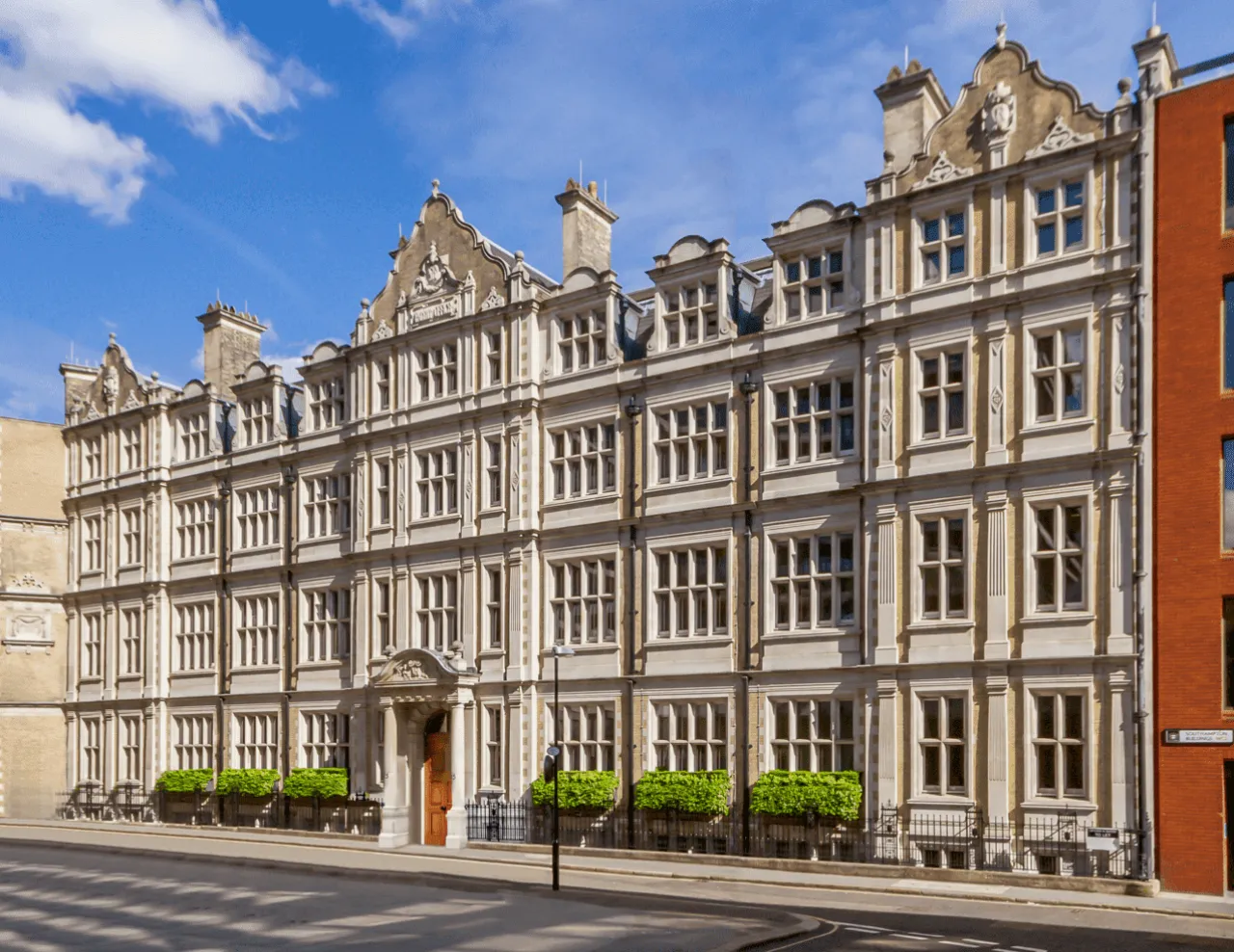
Central Court occupies the former London Patent Office at 25 Southampton Buildings, just off Chancery Lane, where a glass-domed roof, galleried reading room and balconied walkways give the building its distinctive Victorian character. Lincoln’s Inn Fields and the Royal Courts of Justice are a short walk away, while nearby transport connections include Chancery Lane and Holborn stations, with Elizabeth line and National Rail services at Farringdon.
For law firms, the practical features include enclosed private offices with their own secure LAN and six meeting rooms, offering a choice of settings for client discussions and larger meetings.
33 Chancery Lane: contemporary serviced offices in the legal quarter
33 Chancery Lane sits on Chancery Lane, in the heart of London’s legal and professional district, with the Royal Courts of Justice at the southern end of the street and both the City and the West End within easy reach. Where Central Court draws on its Victorian past, 33 Chancery Lane takes a more contemporary approach. Warm furnishings and light-filled interiors frame private offices, lounges and meeting rooms, so focused work, a conference with counsel and time with clients each have a setting of their own.
Chancery Lane station is a four-minute walk away, with Holborn nine minutes and Temple ten. Private offices come with dedicated high-speed connectivity, while video call booths and a quiet room offer privacy for conversations that can’t be taken at a desk. Meeting rooms with intuitive technology can be booked by the hour, half day or full day.
Frequently asked questions
Do law firms need to be on Chancery Lane?
Not necessarily, as the right location depends on the work your firm handles and the journeys your team makes most often. Being close to the Royal Courts of Justice and the Rolls Building can save time for litigation and disputes practices, while firms that mainly host client consultations may prioritise convenient access and suitable meeting rooms.
How much does a serviced office for a law firm in London cost?
Rates depend on the location, building and office available, with private offices at Central Court currently starting from £520 per desk per month. Business rates, utilities, cleaning and connectivity are included, and our team can confirm availability and the full cost of your chosen office when you enquire.
What should a law firm check about confidentiality in a serviced office?
Ask how conversations are protected from being overheard, who can access your office and how your network is separated from those of other businesses. You should also understand the arrangements for handling post, storing documents, disposing of confidential waste and allowing cleaners into locked offices, with the team explaining how these procedures work in practice.
Can a serviced office meet a law firm’s confidentiality obligations?
A serviced office can provide facilities and procedures that support confidential work, while responsibility for meeting your professional obligations remains with your firm. Before committing, involve the person responsible for compliance in reviewing the arrangements, so you can assess whether they support your own policies and the work your practice undertakes.